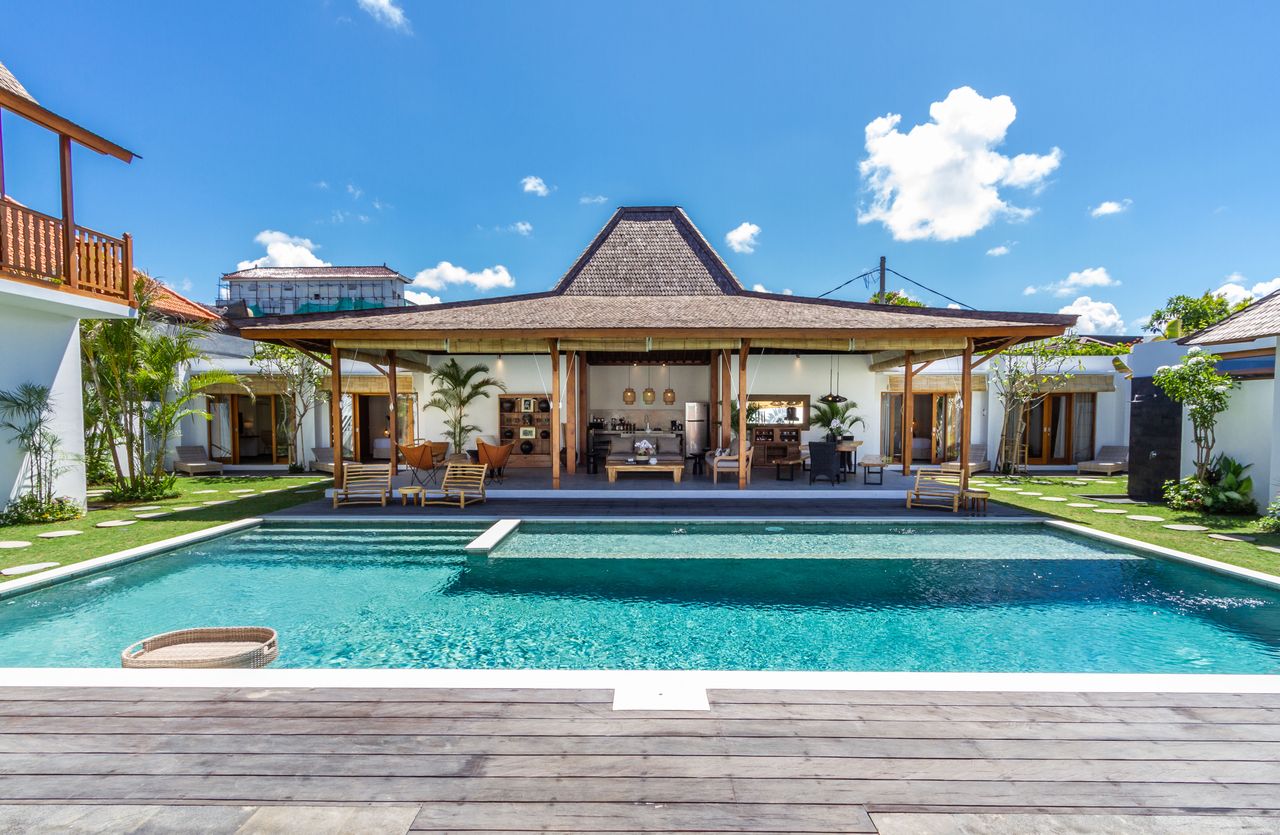
Buying off-plan in Bali means paying a developer for a villa before it is finished, and for a foreign buyer what is bought is usually a lease. The buyer pays in stages against a contract and, for months or years, holds nothing else: no building, no registered right, no certificate. Whatever protects the money has to be written into that contract or checked before it is signed.
Indonesia does have rules for selling homes before they exist. Government Regulation 12 of 2021 sets the conditions a developer must meet before it signs a preliminary sale agreement, the PPJB, and fixes what comes back to the buyer if the deal collapses. Those rules are written for the sale of a house or an apartment unit. Most off-plan villas sold to foreigners in Bali are leases, and a lease is not a sale. We have found no regulation or court decision that extends the PPJB rules to a lease, so for most buyers of an off-plan villa the contract is the only protection there is.
We list off-plan villas in Bali from developers after checking the land, the permits and the zoning. The sections below follow the order in which a buyer meets each risk, from the first document to the day the keys are handed over, or are not.
What you sign when you buy an off-plan villa
Three structures reach a foreign buyer in 2026, and each produces a different chain of documents. A fourth, the company route, has closed for newcomers.
| What you buy | Documents before handover | What the law adds | Final document |
|---|---|---|---|
| Leasehold villa | Reservation agreement, then an agreement to lease that developers often also call a PPJB | The Civil Code’s general rules on contracts | Notarial lease deed, or an assignment of the developer’s own lease |
| House under Hak Pakai, from IDR 5 billion | Reservation, then a PPJB signed before a notary | The PPJB rules of Government Regulation 12 of 2021 | Deed of sale (AJB) before a land deed official, then a certificate in your name |
| Strata apartment, from IDR 2 billion | Reservation, then a PPJB | The same PPJB rules | Deed of sale once the block is split into unit certificates |
| HGB through a new foreign-owned company | Not available | New companies in Bali cannot be licensed for real estate since May 2026 | None |
The letters PPJB turn up on the first three rows, which is where buyers get misled. On a lease the word is the developer’s label for its own contract, and the regulation’s preconditions and refund rules do not travel with the label. What decides which rules apply is what passes to you at the end: a right registered in your name, or a lease.
What the law requires before a developer may sell
For a house or a unit sold with title, the regulation lets a developer market a project early but sign a PPJB only once five things are certain: the status of the land, what is being sold, the building approval (PBG), the shared roads and utilities, and construction of at least 20%. The buyer is entitled to at least seven working days to read the PPJB before signing it. The regulation then sets what happens to the money when the deal ends early.
| Who cancels, and when | What the buyer gets back |
|---|---|
| The developer is at fault, after the PPJB | Everything paid |
| The buyer withdraws during marketing, before any PPJB | The payments, less a deduction of at least 20% and the tax already counted |
| The buyer is at fault after the PPJB, having paid up to 10% of the price | Nothing |
| The buyer is at fault after the PPJB, having paid more than 10% | The payments, less 10% of the price |
| Any refund | Due within 30 calendar days of the signed cancellation letter |
One line in that table reads oddly. For a buyer who walks away during marketing, the regulation lets the developer deduct “at least” 20%, which sets a floor and no ceiling. Legal commentators have pointed to the gap, and we have not found a decision that says how far above the floor a developer may go.
The 20% construction threshold is the rule that matters most for off-plan, and it is also the one most often missed in practice. A titled house or unit sold on a PPJB before the frame is a fifth built, or before the PBG exists, has been sold outside the regulation. That does not void the contract on its own. It does tell you how the developer treats the rules that bind it.
For a lease none of this applies, and the agreement may say anything the parties sign, including that the deposit is never refunded. Reading a lease agreement against the table above still helps: it shows in a minute how far the developer has moved the risk onto you.
The payment schedule is the protection
No Indonesian law requires a developer to hold buyers’ money in a separate account until the villa is delivered. Australia is the usual comparison, because every state there requires off-the-plan deposits to sit in a trust account until settlement. A Bali contract that mentions escrow describes an arrangement the developer chose. The clause should name the bank, the holder of the account and the conditions on which money is released, and if it names none of them it is a word.
What a buyer can control is the shape of the schedule. Each payment should be tied to a stage that can be seen on site and documented: foundation, structure, roof, finishing, handover. Take a villa at IDR 4 billion, with invented figures. On a schedule of 30% at signing, 30% at structure, 30% at roof and 10% at handover, a developer who stops after the roof has received IDR 3.6 billion for a shell, and IDR 400 million is all the buyer still holds. On five equal stages of 20%, the same stop leaves the buyer IDR 2.4 billion paid and IDR 1.6 billion in hand, which is money to finish the house with or to negotiate with.
The percentages are the developer’s to propose. The stages, the evidence for each and the size of the last payment are what a buyer should negotiate. Three documents are worth refusing to pay without:
- a receipt for each payment that names the stage it pays for and the account it went to;
- a copy of the PBG before anything is paid against construction;
- at handover, the signed handover report (BAST) and the building’s certificate of function (SLF), before the final payment.
A delay clause belongs in the same document. It should give a handover date, a grace period, a penalty for each month beyond it, and a right to cancel and be repaid after a delay of set length. A contract with a handover “estimate” and no consequence for missing it leaves the buyer waiting on goodwill.
Taxes and dates that move with the build
On a title purchase, the acquisition duty (BPHTB) of up to 5% falls due on the day the PPJB is signed, under Article 49(a) of the 2022 regional tax law. On an off-plan house that can be a year or more before the deed. The seller’s 2.5% final tax attaches to the PPJB as well. A lease carries no BPHTB. It carries the landowner’s 10% final tax on rent, and a lease priced “net of tax” moves that 10% onto the buyer, which on a long lease is the largest single cost of closing.
VAT on a new villa from a VAT-registered developer is an effective 11%. In 2026 the state bears the VAT on the first IDR 2 billion of a new home priced up to IDR 5 billion, for a foreign buyer with a tax number, but only for a unit that is ready to live in at its first handover. A villa still under construction does not qualify, so whether the relief applies is decided by the handover date. The government said on 30 September 2026 that the relief continues in 2027. When we checked in November, the regulation for 2027 had not been published, and a handover planned for next year is safer priced without it. Rates and worked examples are in Bali property taxes for foreigners.
Checks before the first payment
Most off-plan losses in Bali trace back to something that could have been seen before any money moved. Four checks carry most of the weight.
The developer’s right to the land. A developer building on leased land holds a head lease from the landowner, and nothing it sells you can outlast that lease. A 30-year villa lease running from a 2027 handover ends in 2057; a head lease signed in 2019 for 30 years ends in 2049. Put the two dates side by side. If the developer offers more years than it holds, the landowner has to sign as well.
The building approval. The PBG, which replaced the old IMB, should exist before construction starts and should describe the building being sold, with its floor area and its use. A project that is digging without a PBG number is the first thing the regency’s enforcement teams look for.
Zoning and rice land. On 30 December 2025 a provincial committee and the public order agency halted about 30 villas, some finished and some under construction, on protected rice land in Babakan, Canggu. A villa sold off-plan on such a plot has no route to completion, whatever the contract promises. The plot has to be checked against both the zoning plan and the protected rice-field map.
Track record. Completed projects with handovers are the only evidence that a developer finishes. A developer on its first project has none to show, and then the payment schedule is all the buyer has.
The full order of checks and payments for any developer purchase, off-plan or finished, is in how to buy property in Bali.
When a project stalls
The first step is a written demand to the developer, a somasi, with the contract, the payment receipts and a record of what has and has not been built. From there the route depends on the documents. Where the developer holds the land right and the permits and is building, the dispute is a civil one, a claim for breach of contract (wanprestasi) for repayment and damages. Where the permits never existed or the money was raised on promises that could not be kept, there may be grounds for a criminal report of fraud or embezzlement. Lawyers in Bali advise against going to the police first: a dispute that turns out to be contractual can be turned away as a criminal case, and the time is lost.
Insolvency is the slower ending. Buyers at a Jimbaran condotel were receiving returns from 2013 until the developer went through bankruptcy proceedings in the Surabaya commercial court in 2015 and 2016, and the returns stopped. In that position a buyer holds a claim against the developer and stands among its creditors, behind any bank that holds a mortgage right over the land.
How common this is, nobody can say with a number. We know of no public count of stalled off-plan projects in Bali. A figure of 38% circulates online with no dataset named behind it, and we would not repeat it as a fact.
Off-plan or completed: what the discount buys
Off-plan villas are sold below the price of the finished product, and developers often present the difference as growth: 20% to 25% “during construction”. Both prices are set by the same developer. The gap is a payment for carrying the construction risk, and whether it is enough depends on how much of the price is paid before the risk is gone.
Supply has grown faster than demand. Horwath HTL and C9 Hotelworks counted more than 70 hospitality-managed residence projects on sale in March 2026, about 40% of them in Canggu and Berawa, while foreign arrivals in January to August 2026 ran 1.6% below the same months of 2025. A completed villa for sale in Bali can be inspected for build quality, checked against its SLF and judged on bookings it has already taken. An off-plan villa is judged on the developer and the contract, which is why the contract carries so much of this article.
What we check, and what we don’t do
Before an off-plan project is listed, we check the developer’s land right against the terms it offers, the PBG, the zoning and the payment schedule, and we tell a buyer when we would not go ahead. We take no buyer money at any stage: payments go to the account named in the agreement. We do not offer nominee structures, and we do not quote rental returns as a reason to buy an unbuilt villa.
Off-plan villas in Bali: FAQ
Can I get my reservation deposit back?
On a house or unit sold with title, a buyer who withdraws before the PPJB gets the payment back less the deduction the regulation allows. On a lease, the reservation agreement decides. The clause worth asking for ties the refund to the result of the checks: if the land, the PBG or the zoning fails, the deposit comes back in full, by a stated date.
Is a guaranteed rental return on an off-plan villa enforceable?
It is a promise by whoever signs it, usually the developer or its management company, and it is worth what that company is worth. Check who signs, for how many years, what happens if the villa is late, and whether the “guarantee” is part of the price paid back. The Jimbaran returns above were guaranteed too.
Can I buy an off-plan villa without coming to Bali?
Yes. The viewings and checks can run remotely, and a notarial deed can be signed by an attorney under a power of attorney that names the property and the act. A power signed abroad needs an apostille, which Indonesia has accepted since 4 June 2022, or consular legalisation for a country outside the convention.
Does an off-plan apartment carry the same risks?
Mostly, with one difference. A strata unit sold with title falls under the PPJB rules, so the 20% threshold and the refund table apply. The catch sits under the block: the unit certificate can be issued only after the building is split into units, and on HGB land the route to a certificate in a foreign name is still unsettled.
This article describes the rules as they stood on 21 November 2026 and is general information, not legal advice on a specific contract. Horizon Estate lists properties for sale in Bali from developers, off-plan and completed, with the title type and the stage of construction shown.